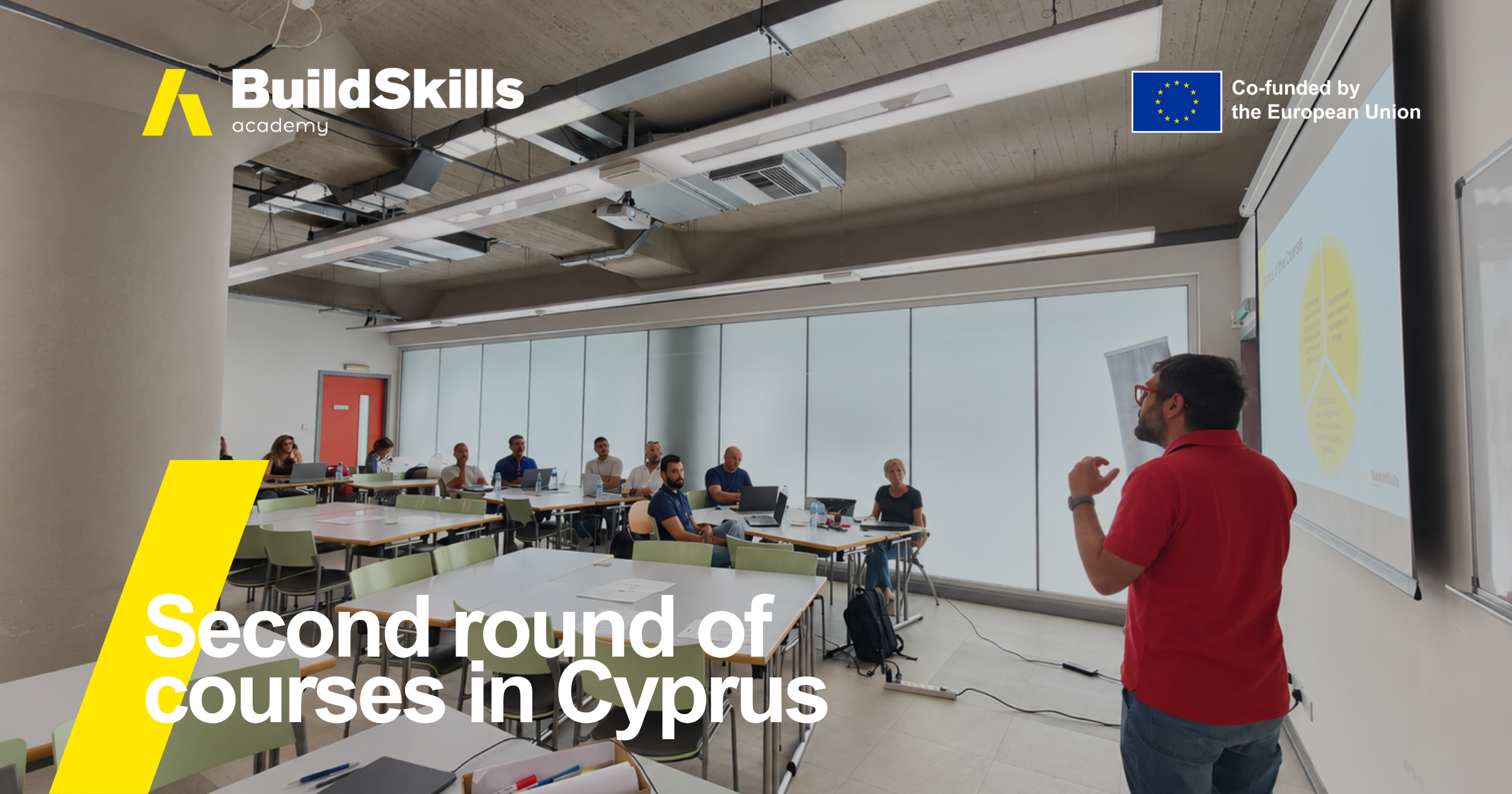
The Centre for Lifelong Learning and the Department of Civil Engineering and Geomatics of the Cyprus University of Technology (CUT) successfully delivered the second round of the course “Bio-inspired Innovation and Design for Sustainable Engineering Solutions”, offering professionals the opportunity to explore how principles found in nature can inspire more sustainable approaches to engineering, design and the built environment.
The course was offered as part of the BuildSkills Academy project and was designed to introduce participants to the principles and methodology of biomimicry, an approach that looks to nature’s systems, processes and strategies as a source of inspiration for addressing human design and engineering challenges.
Following the experience of the first round, the course was offered again in a more flexible and accessible hybrid format, combining face-to-face learning at CUT in Limassol with online sessions. This format aimed to make participation easier for professionals while maintaining the interactive and practical nature of the training.
Throughout the course, participants explored how biological systems and natural processes can inform the development of more sustainable and innovative solutions for the built environment.
Participants were introduced to the why, what and how of biomimicry through practical tools, real-world examples and applied exercises. The course explored nature-inspired approaches to engineering challenges, sustainability and climate resilience, while also introducing tools such as Life-Cycle Assessment (LCA) and systems mapping to support more informed design decisions.
Across the first and second rounds, the course has reached around 20 participants, bringing together professionals and learners interested in applying biomimicry principles to more sustainable engineering and design solutions.
By the end of the training, participants had the opportunity to strengthen their understanding of:
- the principles and methodology of biomimicry;
- the relationship between natural systems and sustainable design;
- ways of translating biological strategies into engineering and design solutions;
- the use of bio-inspired thinking as a tool for innovation and problem-solving;
- the potential of biomimicry to contribute to more resilient and sustainable built environments.
Both rounds provided an opportunity to gather feedback on the relevance and practical value of biomimicry training for professionals working in the built environment.
The course forms part of the broader work of BuildSkills Academy – Academy for Transitional Skills in the Built Environment, which aims to support the development of the skills needed for the green and digital transformation of the construction sector.
Through the development and piloting of innovative training programmes, BuildSkills Academy seeks to strengthen vocational and professional education, address emerging skills gaps and support professionals in responding to the changing needs of the built environment.
The Academy for Transitional Skills in the Built Environment – BuildSkills Academy is co-funded by the European Union through the Erasmus+ Programme, under Grant Agreement No. 101104419.
More information about the project and the rest of the pilots across Europe:
Website: https://buildskillsacademy.com
LinkedIn: https://www.linkedin.com/company/buildskills-academy/
Facebook: https://www.facebook.com/BuildSkillsAcademy
Το ΤΕΠΑΚ στηρίζει έμπρακτα την ισότιμη συμμετοχή των ατόμων με αναπηρία στον αθλητισμό
The Centre for Lifelong Learning and the Department of Civil Engineering and Geomatics of the Cyprus University of Technology (CUT) successfully delivered the second round of the course “Bio-inspired Innovation and Design for Sustainable Engineering Solutions”, offering professionals the opportunity to explore how principles found in nature can inspire more sustainable approaches to engineering, design and the built environment.
The course was offered as part of the BuildSkills Academy project and was designed to introduce participants to the principles and methodology of biomimicry, an approach that looks to nature’s systems, processes and strategies as a source of inspiration for addressing human design and engineering challenges.
Following the experience of the first round, the course was offered again in a more flexible and accessible hybrid format, combining face-to-face learning at CUT in Limassol with online sessions. This format aimed to make participation easier for professionals while maintaining the interactive and practical nature of the training.
Throughout the course, participants explored how biological systems and natural processes can inform the development of more sustainable and innovative solutions for the built environment.
Participants were introduced to the why, what and how of biomimicry through practical tools, real-world examples and applied exercises. The course explored nature-inspired approaches to engineering challenges, sustainability and climate resilience, while also introducing tools such as Life-Cycle Assessment (LCA) and systems mapping to support more informed design decisions.
Across the first and second rounds, the course has reached around 20 participants, bringing together professionals and learners interested in applying biomimicry principles to more sustainable engineering and design solutions.
By the end of the training, participants had the opportunity to strengthen their understanding of:
- the principles and methodology of biomimicry;
- the relationship between natural systems and sustainable design;
- ways of translating biological strategies into engineering and design solutions;
- the use of bio-inspired thinking as a tool for innovation and problem-solving;
- the potential of biomimicry to contribute to more resilient and sustainable built environments.
Both rounds provided an opportunity to gather feedback on the relevance and practical value of biomimicry training for professionals working in the built environment.
The course forms part of the broader work of BuildSkills Academy – Academy for Transitional Skills in the Built Environment, which aims to support the development of the skills needed for the green and digital transformation of the construction sector.
Through the development and piloting of innovative training programmes, BuildSkills Academy seeks to strengthen vocational and professional education, address emerging skills gaps and support professionals in responding to the changing needs of the built environment.
The Academy for Transitional Skills in the Built Environment – BuildSkills Academy is co-funded by the European Union through the Erasmus+ Programme, under Grant Agreement No. 101104419.
More information about the project and the rest of the pilots across Europe:
Website: https://buildskillsacademy.com
LinkedIn: https://www.linkedin.com/company/buildskills-academy/
Facebook: https://www.facebook.com/BuildSkillsAcademy